
The promise of artificial intelligence in marketing is irresistible: perfect efficiency, zero errors, and a perpetually optimized machine that generates leads while you sleep. Every platform, from Google to Meta, is pushing for “full automation,” turning over the keys to the algorithm.
But at Zeulis, we see a dangerous conflict emerging—the true battle of the future isn’t Human vs. AI; it’s AI vs. AI.
We are referring to the struggle between human-guided, strategic AI and autonomous, set-it-and-forget-it AI. While AI tools are non-negotiable for speed and analysis, complete dependency on autonomous systems is the single fastest way to surrender your competitive edge and become indistinguishable from every other player in your market.
This post reveals the critical limitations of full dependency and outlines the essential human overlay needed to ensure your marketing budget delivers real, differentiated results.
The Irresistible Case for AI Integration (The “Why We Use It”)
First, let’s be clear: AI is the most significant productivity tool in marketing history. Any business ignoring it is already losing. The core value of AI lies in its ability to handle the “what” and the “how much.”
1. Speed and Efficiency
AI can perform technical, repetitive tasks in seconds that would take human teams days. This includes:
- A/B Testing: Running thousands of headline variations or ad creative combinations simultaneously to find the statistical winner.
- Data Aggregation: Consolidating data from dozens of sources (CRM, Google Analytics, social platforms) into a unified, clean report.
- Ad Bidding: Optimizing bids on paid platforms every millisecond to ensure the lowest cost-per-conversion.
2. Pattern Recognition and Prediction
AI excels at finding subtle patterns in massive datasets that humans simply cannot detect.
- It can predict which leads are most likely to convert based on hundreds of behavioral signals.
- It identifies audience segments with uncanny precision, allowing for hyper-focused ad targeting.
By handing over these technical, high-volume tasks, a marketing team is freed up to focus on strategy. This is the foundation of a successful AI-supported workflow.
The Fatal Flaws of Full AI Dependency
(The “Why We Don’t Automate Everything”) 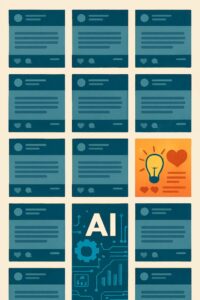
The problem arises when businesses mistake efficiency for strategy. When you allow AI to handle 100% of your marketing, you are essentially outsourcing your brand identity and your ability to connect with humans.
1. The Death of Creative Uniqueness (The “Same-ness” Problem)
AI models are trained on existing data. They are masters of interpolation (filling in the blanks based on what is already popular). They are poor at extrapolation (creating something entirely new, disruptive, or counter-intuitive).
When every competitor uses the same automated tools to generate social posts, email subject lines, or ad copy, the output begins to converge.
- The Result: A constant stream of “perfectly optimized, statistically average” content. Your brand loses its unique voice, becoming a bland echo in the marketplace. Differentiation is the first casualty of full automation.
2. The Lack of Emotional and Cultural Context
Marketing at its best is about empathy and solving human problems. AI, currently, lacks the emotional intelligence (EQ) required for genuine, breakthrough connections.
- Ethical and PR Blind Spots: AI cannot assess the nuance of a sensitive cultural moment, predict a negative public reaction to an ad campaign, or understand the specific, non-quantifiable sentiment behind a major news event. This often leads to tone-deaf marketing disasters that human review could have prevented.
- Unforeseen Customer Needs: The biggest marketing innovations often come from understanding a customer’s unspoken desire, something that doesn’t yet exist in the training data. This human intuition is irreplaceable.
3. The Algorithm Trap
When you rely entirely on platform-based automation (like Google’s Performance Max or Meta’s Advantage+), you cede control to the very system you should be trying to outsmart.
- Loss of Insight: Automated AI gives you phenomenal results data, but poor why data. If a campaign suddenly tanks, the human marketer is often left with no visibility into which audience, creative, or placement failed, making true learning impossible.
- Vendor Lock-In: Your campaign becomes perfectly optimized for that specific platform, reducing your ability to pivot, diversify, or build assets that are valuable outside of the ad ecosystem.
The Strategic Synergy:
The Human Overlay Model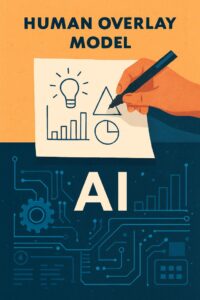
The winning strategy for the next decade is not choosing one over the other, but defining a clear separation of duties. The most effective marketing teams employ a Human Overlay Model where the strategic brain remains firmly attached to the technical engine.
Phase 1: AI Handles the Technical Heavy Lifting
The machine’s role is to generate, test, and analyze vast amounts of data. This includes:
- First Drafts: Generating 10 variations of content or copy based on a human brief.
- Data Cleansing & Reporting: Handling all the complex number-crunching and visualization.
- Optimization: Automating bidding and targeting within parameters set by the human.
Phase 2: The Human Provides the Strategic Filter
The human marketer’s role is to bring intuition, culture, and ethics to the process.
- The 1% Rule: The human marketer must inject the 1% of creative uniqueness—the headline twist, the visual metaphor, or the counter-cultural idea—that makes the AI-generated content truly stand out.
- Audience Empathy: Validating AI’s segmented audiences against real-world customer interviews and feedback to ensure the targeting is not just statistically correct, but emotionally resonant.
- Ethical Guardrails: Applying brand safety standards, ensuring ethical data use, and protecting the brand’s reputation—tasks AI cannot yet perform reliably.
Conclusion: The Clarity of Balanced Marketing
The battle of AI vs. AI will be won by the agencies and businesses that understand AI is a brilliant calculator, not a visionary CEO. Full automation leads to competitive convergence, draining your brand’s personality and relying on statistical averages.
At Zeulis, we believe true digital clarity comes from merging AI’s efficiency with human strategy. We use AI to remove the noise, but we use human intelligence to craft the unique message that actually penetrates the market.
If you are ready to move beyond the average and inject true, strategic vision back into your marketing, it’s time to apply the Human Overlay Model.